
FROM THE LAB · FIELD NOTE · SEPTEMBER 29, 2026
Following Yellow
An Experiment in Seasonal Time — Part I
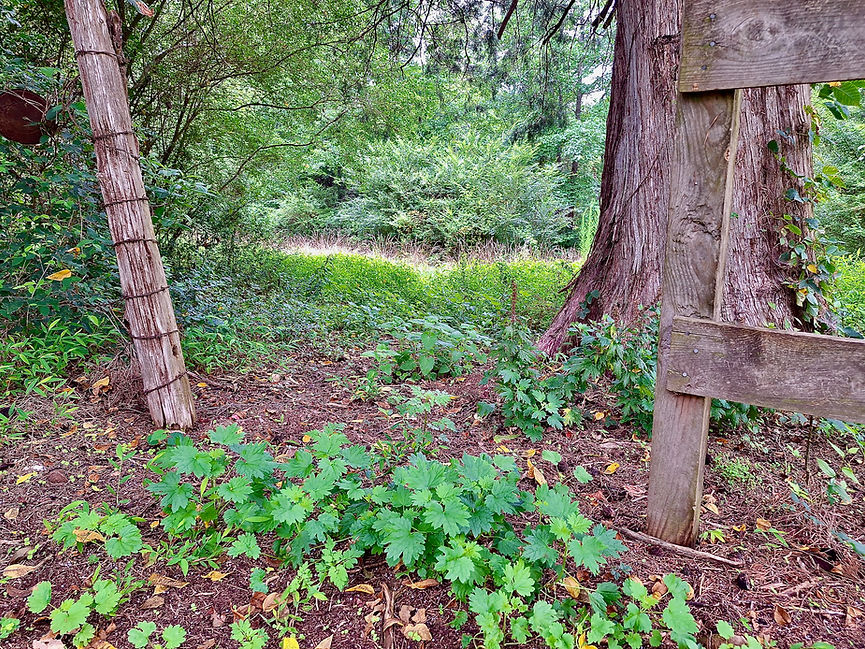
There’s an old-timey wooden fence that divides the backyard from the pastures and woods beyond our house. We call it “Highway 1” because the squirrels run along it at various times of the day in their comings and goings.
At the far end is an opening where a gate once stood, back when this was a working hay farm. The gate is gone, but the opening remains. For me, it has become a threshold between the “real world” and what I call “the enchanted forest”—a network of fields, paths, trees, and other landmarks I’ve been exploring in the ten years we’ve lived here.
This morning, I stepped through that gateway and followed yellow.
I didn’t realize I was on a mission until the mission called out to me in the form of crownbeard, goldenrod, horsenettle berries, and straw-yellow hay bales.

A while back, I had been In Search of Blue, looking for the tiny blue dayflower that appears along the edge of the woods. Blue had required searching. Yellow was different. Once I began noticing it, yellow seemed to be everywhere.
That’s one of the things I’ve become interested in through these experiments in attention: give the senses something specific to follow, and the world begins to reorganize itself around it. My pace slows.
My attention moves outward. I stop thinking quite so much about where I’m going and begin noticing where I actually am. Following a color becomes a way of coming back into relationship with the landscape—and, through the landscape, with myself.
What I noticed was: this wasn’t the yellow of spring.
Spring yellow is daffodil yellow. Forsythia yellow. It arrives alongside that tender yellow-green of new leaves, before the woods have filled in and the green has become dense. There’s something more open about spring yellow. Almost innocent.
Spring yellow is emergence.
The yellow I was following this morning felt different. It was denser. More golden. Seasoned.
Something seasoned has passed through time. It has acquired complexity and character. Maybe that’s what happens to yellow as the year progresses. Spring yellow announces itself brightly against a world just waking up. But by late September, yellow has lived through summer.
The crownbeard has grown tall. The goldenrod is beginning to emerge. The prickly horsenettle berries are full, and the hay has been cut and rolled into enormous bales in the north pasture I affectionately call “Greenland.”
Yellow is beginning to contain time.
Maybe that’s why we so easily call the yellows of autumn gold. Golden leaves. Golden fields. Golden light. Gold belongs to the latter part of the cycle.
Spring yellow is light becoming a thing.
Autumn yellow is light after it’s lived awhile.
But we aren’t quite there yet.
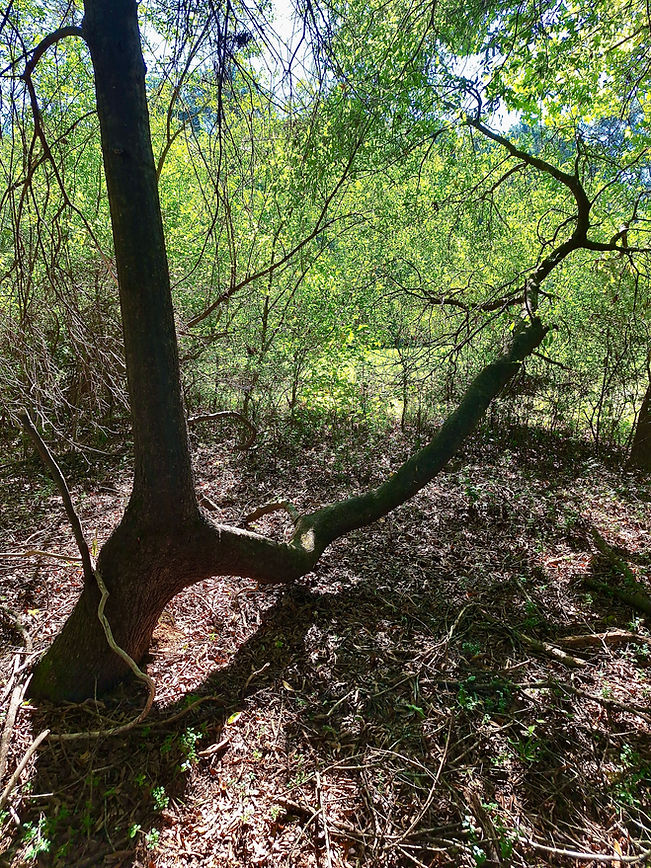
Eventually I made my way to the Reclining Buddha Tree, an old tree in the North Woods whose trunk stretches almost horizontally above the ground before rising again.
I first encountered the reclining Buddha while traveling in Asia many years ago. This tree somehow evokes it. Its long, low trunk practically invites you to climb aboard, lean back, put your feet up, and contemplate life for a while. And so, somewhere along the way, it became the Reclining Buddha Tree. Only recently have I come to appreciate how fitting the name is: the reclining Buddha is itself associated with transition, with one state giving way to another.
I often stop there to do exactly that. But not today. It was still in shadow.
Standing there, I realized I had almost expected autumn to be waiting for me. After all, the calendar says it is autumn. But the tree said otherwise: Not yet.
The sun is still moving. The angle of the light is changing. The days are shortening. But here in central North Carolina, late September still feels like summer. Temperatures are still reaching into the eighties. The woods are overwhelmingly green. And there are still ants.
Earlier this summer, while photographing a mushroom, I acquired several ant bites on my arm. So the Buddha Tree’s message this morning was both philosophical and practical:
Don’t sit on me yet, Robin. You’ll get ants in your pants.
Fair enough.
The Reclining Buddha Tree has become a kind of sundial. Not a sundial that tells me whether it’s ten in the morning or three in the afternoon, but one that tells another kind of time: seasonal time.
How does the light fall on the trunk? Is it cool enough to sit on? What color are the leaves? What’s going on in the field around it? Perhaps the tree knows where we are in the season better than the calendar does. And perhaps yellow does too.
Yellow, after all, is also the color of caution. The yellow of a traffic light does not say Stop. It says: Pay attention. Something is changing.
That seems to be what the landscape is saying now. Not summer. Not quite autumn. A threshold.
And so Following Yellow has become an experiment in perceiving seasonal time—not by the calendar, but by watching what yellow is doing. Today, yellow is crownbeard and goldenrod. Hay and horsenettle berries. It’s deeper than the yellow of spring but not yet the full gold of autumn.
It’s saying: Not yet.

Tomorrow I leave for Vermont.
I’ll be traveling north, taking this experiment with me. I know what yellow is doing here in North Carolina. Now I want to see what yellow is doing there.
Perhaps autumn will be farther along. Perhaps the light will fall differently. Perhaps yellow will already have tipped toward gold. I don’t know. That’s the experiment.
For now, I’m standing at one threshold, about to cross another.
The question I’m carrying north is:
Where is autumn now?