
Pause Pillows
Instruments for Conscious Pausing

The Pause Pillows didn't begin with a name.
They began with a question.
After creating The Face Cloud™, I became curious about degrees of sensory immersion and states of attention. The Face Cloud was immersive—weight, darkness, muffled sound, coverage extending beyond the face toward the throat and chest. I associated it with deep relaxation, sleep, and letting go.
But what if I didn't want to go quite that far?
What if I wanted enough sensory input to change my state without completely removing myself from conscious engagement?
I wanted something lighter—not necessarily only in weight, but in depth.
Conscious Unwinding
At the time, I had begun experimenting with meditation, although I hesitate to call it that. Mostly, I was trying to become still and empty my mind.
And I fidgeted.
Physically. Mentally. Emotionally.
Simply lying still didn't necessarily create stillness. I needed a focal point—something that would allow me to settle without sending me toward sleep.
I began with a small amount of weight on my forehead.

An early Forehead Pillow
I had read about the “third eye,” although I didn't have enough knowledge of chakras or yogic traditions to claim any expertise there. I briefly considered making chakra pillows, but that felt inauthentic—as though I were imposing a system onto an experience I was still trying to understand.
So instead, I experimented.
What happened if I put a little weight here? What about there?
How much was enough?
The forehead seemed to want very little.
For a while, I also experimented with something much larger. I called it the Eye Cloud—an intermediate step between The Face Cloud and the smaller weighted pillows. It covered the eyes, cheeks and ears: less immersive than The Face Cloud, but considerably more enveloping than a small, localized pillow.
I made several versions, experimenting with shape, weight and construction. Ultimately, I found myself more interested in what happened when weight was concentrated in smaller, more specific areas of the body, and the Eye Cloud experiment receded.

The Eye Cloud in process—from weighted insert to finished prototype.
The lower abdomen, for example, welcomed considerably more weight. Sometimes I simply placed smooth stones there. Another place I kept returning to was the upper sternum, near the heart.
Each placement seemed to have its own character.
And gradually I became less interested in what I should experience and more interested in a simpler question:
What do I actually notice?
How much weight is enough?
Finding the right weight became its own experiment.

Testing weight and materials: steel bearings for the smaller pillows and flaxseed for larger forms.
I tried different materials before settling primarily on tiny steel ball bearings for the smaller pillows and flaxseed for larger ones. Before there were finished pillows, there were Ziplock bags filled with different quantities of steel bearings that I moved around my body, adding and subtracting weight as I went.
Eventually I began sewing small pockets from stiff muslin to contain them. This presented another problem: one tiny steel bearing would invariably slip beneath my sewing-machine needle and—pop.
Back to square one.
So I started sewing the filled pockets closed by hand.
The cloud shape remained. I liked its proportions and the way its rounded edges seemed to expand outward from a center. I became particularly enamored of a purple cosmic fleece patterned with stars and bursts of light and also the sunset pattern seen below, positioning the template so that a starburst (or sunburst) landed near the focal point. This felt symbolic.
There was experimentation with weight, material, and construction.
But there was also play.

Experiments in scale, weight and degrees of sensory immersion
Giving Me Pause
I wasn't calling them Pause Pillows then.
That came much later, as I began developing The Sensory Lab and thinking more deeply about the meaning of pause.
There is stopping for a moment.
And then there is something that gives us pause—something that interrupts the expected sequence long enough for us to notice.
I began to understand these little weighted objects as instruments for conscious interruption: a break in an established pattern that creates a small space before whatever comes next.
Pattern → Pause → Perception → Possibility
The possibility doesn't have to be dramatic. Perhaps nothing changes at all.
But something could.
I became curious about another possibility:
Could I go inward without following the familiar path of thought?
Could I go somewhere else within?
I needed something to help me feel my body and feel myself IN my body.
A little weight gave my attention somewhere else to go: pressure, breath, heartbeat, the rise and fall of my body beneath the pillow.
Not thinking about the body.
Experiencing myself bodily, from within.
And sometimes, apparently, the weight has other ideas.
While working on this story, I tried to photograph a Pause Pillow resting on my chest. Minnie climbed aboard instead.
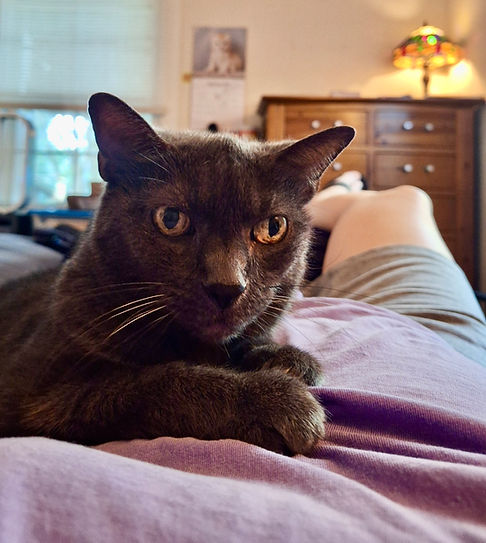
Sometimes a Sensory Pause becomes a Sensory Paws, or better yet: a Minnie Pause.
Her eyes were saying: "Why do you need those when you have Me, mommy?"
Revisiting the Pause
Before Minnie commandeered the experiment, I had been lying with one of the old pillows on my upper sternum.
I noticed my breath and heartbeat beneath the weight. My body settled. There was a softening—a little letting go physically, mentally, and emotionally.
A few words came to mind:
Stillness. Safe. Contained.
And, perhaps most simply:
a small hug.
The outside world felt further away.
Not gone.
I had gone inward without going under.
The pillow introduces sensation and creates an occasion for perception. All that is required is for the person to simply take notice.
Still in the Lab
One place I continue to find particularly interesting is the upper sternum—the manubrium, to use the rather unlovely anatomical term.
Years ago, I used one of the cloud-shaped pillows there. I liked the sensation, but the shape never felt quite right.
Recently, I returned to the question:
What if the pillow itself responded to the anatomy beneath it?

Looking more closely at the anatomy of the sternum—and letting the body suggest the shape.
I've begun designing a new shape, wider across the upper sternum and narrowing as it extends downward along the sternum. I'm considering flaxseed rather than steel bearings.

The proposed pattern for a new Sternal Pause Pillow. Prototype #1 has yet to be made.
I don't know whether it will work. I haven't made it yet. Which is precisely why it belongs here.
This is a Lab.
And perhaps the Pause Pillows belong to an even larger question—one that extends beyond weighted objects.
What happens when an object, a sound, a place—or something unexpected encountered along a path—gives us pause?
How might we create physical environments that help us settle, soften, notice, and perhaps even change course?
Increasingly, this is the question I find myself returning to:
How do we create conditions that allow something different to happen?
Not make something happen.
Allow.
And then—
Just notice.