
The Sanctuary
Holding Space For Myself

Holding Space
For most of my professional life, I have held space for other people. As a licensed massage and bodywork therapist, it’s part of the work. You create an environment in which another person can settle. You listen. You pay attention. You try not to impose. You remain present while someone else’s body gradually lets go of whatever it has been holding.
After I returned to massage work during the pandemic, that holding began to feel different. People seemed to arrive carrying more. Sometimes they were unusually quiet. Sometimes everything came spilling out. There was tension in bodies, certainly, but there was also an undercurrent of unease that seemed harder to name.
And I was carrying things, too.
Eventually, a question occurred to me:
I am very good at holding space for other people. But who is holding space for me?
The answer, at least in part, was another question:
Could I learn to hold space for myself?
It Started With Two Pillows
The Home Sanctuary did not begin with a room.
It began with two couch pillows.
During the pandemic, when sleep was sometimes difficult, I discovered that placing pillows alongside my face created a feeling of enclosure that helped me settle. Those first experiments eventually became The Face Cloud, a weighted sensory pillow that surrounded the sides of my face while leaving an opening for breathing.
I began experimenting with it during the day as well. I would lie on my bed with The Face Cloud over my eyes and attempt to “meditate,” for lack of a better word. I was not trying to empty my mind or achieve a particular spiritual state. I wanted to remain conscious while I unwound—to notice what happened as my body settled and my attention softened.
I listened to singing bowls and other spare, sustained sounds. I experimented with quiet, repetition, and ritual. I began noticing not only how these experiences felt, but how my anticipation of them seemed to matter. After a while, merely beginning the familiar sequence seemed to tell me: We’re going somewhere else now.
That fascinated me. Could repeated sensory and environmental cues help us enter a particular state of being?
I didn’t know, but I wanted to find out.
The Bedroom Problem
There was one problem with my experiments.
I kept falling asleep.
This wasn’t entirely surprising; I was lying on my bed after all. And my bedroom had other problems. There was stuff—things to look at, things that reminded me of something else I needed to do. The pile of books in the corner kept telling me it needed to be straightened.
It occurred to me that the bedroom was actually doing its job too well. It was a place for sleep—for what I began thinking of as unconscious unwinding.
But I was becoming interested in something different:
Conscious unwinding.
I wanted to remain present enough to notice what was happening while I settled. I didn’t want an environment that knocked me out. I wanted one that might allow me to hover somewhere between ordinary activity, that liminal space between awake and sleep: quiet, settled, receptive, but still aware.
That seemed to require a different room—and, perhaps more importantly, a different intention.
A Room With No Occupation
At first, it would have been easy to call what I was imagining a meditation room or perhaps a "she shed." But neither description felt right.
A she shed (or man cave) usually has an occupation. You go there to read, paint, craft, write, or work on something. A meditation room already tells you what you’re supposed to do when you enter it.
I wanted a room with no occupation at all and no agenda.
I had spent enough of my life doing. What would happen if I created a place to simply be?
That distinction—being rather than doing—had interested me since graduate school, when I first began thinking about cultural differences in how we value productivity, activity, achievement, and stillness. Over time, I had become increasingly interested in the possibility that doing nothing visible is not necessarily the same thing as doing nothing.
The Sanctuary became an experiment in something that now feels almost radical:
Radical Permission to Have No Occupation
And then something unexpected happened:
Attention Became the Occupation.
But the room I had in mind is shared with my partner, and because of this, it was not mine alone to shape.
So, I went outside.
I Went Outside
I walked through the pasture and into the woods. Sometimes I had a destination. Often, I rambled. I stopped when something caught my attention: light coming through the trees, a shadow crossing the path, an acorn, a walnut, something I could not identify.
Gradually, I began to recognize that nature was offering me something I had been trying to construct indoors: space.
Nature did not require me to explain myself. It did not need me to be productive, cheerful, certain, or even particularly interesting. It did not ask me to become anything other than what I was at that moment. In that sense, nature was holding space for me.
It occurred to me that my cat, Minnie, had been holding space for me, too without my knowing it.


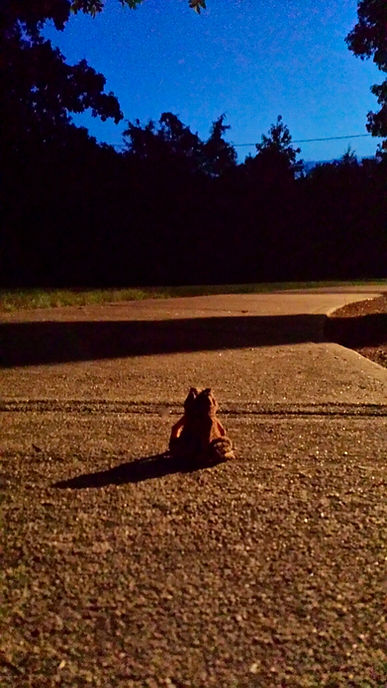
She had always done it. This is how she looks when she does it. I simply had not recognized it as such. Minnie could sit quietly near me, looking at me with that steady gaze of hers. She did not need to fill the silence, solve a problem, or direct the experience. She was simply present.
Nature gave me spaciousness. Minnie gave me companionship within it.
Both helped me recognize what I was trying to learn:
Could I offer that same kind of presence to myself?
The Sanctuary had begun as a room I wanted to create around me. Gradually, it was becoming something I was learning to create within.
What Happens When You Stop Trying to Stop Your Mind?
As I rambled through the woods, my mind rambled with me.
The point, I discovered, wasn’t necessarily to make it stop. Where did it go? What conversation did I keep replaying? What was I anticipating? What made me angry? What was I worried about? Why did that particular memory appear? What was I feeling as I thought about it? Why did I keep circling back to the same thing?
Instead of treating the wandering mind as a problem, I could turn my attention toward it. I began thinking of this as entering Observer mode.
The Observer, as I understand it now, is not a Higher Self. It isn’t more evolved than the rest of me or sitting above my thoughts, deciding which ones are enlightened and which need improvement. The Observer is neutral and curious.

Sometimes that small amount of distance is enough to notice, There it is again, and then ask a much larger question:
Who am I when I stop answering according to who I’ve been told I’m supposed to be?
That question can get uncomfortable. We accumulate labels and roles. We inherit beliefs from families, religions, cultures, schools, and communities. We absorb ideas about what a good person thinks, what a successful person does, what we’re allowed to want, and what we’re supposed to believe.
Some of those beliefs may fit us beautifully. Some may not. The only way I know to distinguish between them is to become curious enough to look.
Not necessarily to fix.
First, just to look.
Containment
This brings me back to holding space. We often talk about being able to hold space for another person, but I’ve become equally interested in another question:
Can I be a container for myself?
Can I contain a difficult feeling without immediately trying to get rid of it? Can I have a thought without acting on it? Can I hold two contradictory ideas without forcing myself to choose one immediately?
Can I discover something about myself that I don’t particularly like and become curious about it before judging it? Can I allow a question to remain unanswered? Can I sit with myself.
I don’t know is a perfectly legitimate answer.
And perhaps most radically, in an age when so much of our interior lives can become public: Can I discover something about myself without telling anybody?
I have an edict for myself:
TELL NO ONE.

I don’t mean that as an instruction for anyone else. It is something that works for me. It reminds me that I am allowed to have a private self.
I do not have to turn every realization into a declaration. I don’t have to explain every feeling, publish every opinion, or immediately make another person part of something I am still discovering.
Some things can remain inside the container.
Some things can remain mine.
Modes of Engagement
Originally, I organized the Sanctuary into “levels.” I don’t particularly like that language anymore.
A level suggests advancement and achievement. Level One leads to Level Two, which leads to Level Three, and presumably, if you’re very good at being still, you eventually win the Sanctuary. That language no longer feels quite right to me.
I think of them now as Modes of Engagement. You might move among them. One isn’t better than another. On some days, the first may be all you need.
𑁍 REST
Become still enough to notice. There doesn’t have to be an agenda. Let your mind wander and notice where it goes. Don’t try to stop it. Notice your body. Listen. Feel.
Allow yourself to have no occupation.
𑁍 REGULATE
Discover what helps you settle or shift. Perhaps it’s silence. Perhaps sound, breath, touch, a particular position, a walk outside, a weighted object, an acupressure point, or something entirely different.
The question isn’t What is supposed to work?
It’s What happens when I try this?
𑁍 REFINE
Turn toward what asks for your attention. Sometimes something keeps appearing: a relationship, an old belief, a resentment, a fear, a pattern, or a question you’ve been avoiding.
This mode is more active. Instead of simply noticing what arises, you intentionally engage with something. That doesn’t mean everything should be excavated alone. Some experiences are too painful, overwhelming, or complex to explore safely without support.
Holding space for yourself can also mean recognizing when you need someone else to help hold it with you.
𑁍 INTEGRATE
Carry what you discover beyond the room.
Eventually, you have to open the door. The purpose of a Sanctuary cannot simply be to become very good at feeling peaceful inside one particular room.
Can something you practiced there come with you? Can you recognize yourself beginning to loop before the loop takes over? Can you become curious in the middle of an ordinary day? Can you tolerate I don’t know? Can you remember that you don’t have to respond immediately? Can you contain yourself long enough to choose what happens next?
That question would eventually lead me beyond the Home Sanctuary and into other experiments.
But that is another story.
Radical Permission
Looking back, I think the Home Sanctuary was ultimately a place where I began giving myself permission:
𑁍 Permission to have no occupation.
𑁍 Permission not to know.
𑁍 Permission to change my mind.
𑁍 Permission to contradict an earlier version of myself.
𑁍 Permission to discover something I didn’t want to discover.
𑁍 Permission to question what I had inherited.
𑁍 Permission not to turn every discovery into a declaration.
𑁍 Permission to keep something for myself.
And perhaps, underneath all of those:
Permission to be.
The Home Sanctuary never became the fully realized room I once imagined. Pieces of it appeared in other places and other experiments. Some of its ideas changed. Some I discarded completely. Others followed me into work I couldn’t have imagined when I first placed two couch pillows beside my face.
The physical spaces that grew from those discoveries belong to the next part of the story. But the question underneath it remains:
Can the conditions around us help us become quiet enough to encounter ourselves?
And if they can, what might we notice?
Maybe the Sanctuary was never only a room. Before it could become a physical place, it had already begun taking shape within me.
I am still creating it.
BE.